Pages

Showing posts with label 1963. Show all posts

Wednesday, March 18, 2015

Marseille

The March 15th, 1963 edition of Marseille Magazine carried an intriguing profile of Searle accompanied by a couple of photos and a drawing I'd not seen elsewhere. The article states he was in the city on assignment for Life magazine to cover the trial of the 'pétanque gang' but missed the appointment due to being bedridden with flu since arriving in France. He made do with the testimony of lawyers, judges and press photographs.

' . . . pour assister, à Marseille, au procès du 'gang de la pétanque', il a traverse l'Atlantique, comme envoyé special du magazine 'Life'. Mais il a dû réaliser son reportage-dessiné à travers les témoignages des avocats, des juges, des journalistes at à l'aide de documents photographiques, une grippe l'ayant cloué au lit dès son arrivée en France.'

I don't think the drawings were ever published in Life but I believe these are the drawings Searle made. The pétanque players are in the collection of the Wilhelm Busch – Deutsches Museum für Karikatur und Zeichenkunst, Hanover.


This stunning panorama of the Marseille palais de justice is held at the Billy Ireland Cartoon Library & Museum at OSU, Columbus, Ohio. It's a large format drawing and Searle took great care with the likenesses of all the accused and the defender and prosecutor, noting their names along the bottom edge of the picture.

Signed and dated lower right. Caricatures identified by the artist: Voiron, Bonacorsi, Maitre Paoli (defense), A. Ceccaldi, Maitre Tramoni (defense), Donnat, Ricci, Quaranta, Bernasconi, Hugues, Bontempi, David, E. Ceccaldi, Alardon, Agaccio, Maitre Grisoli (defense)


The Billy Ireland Library also has this depiction of the judges presiding over the case: Gaudaire, Vincentelli (President), Lucciardi
 The article is somewhat obsessed with the artist's financial rewards since becoming 'le dessinateur le plus féroce du monde' stating that his drawings for French, American, English, Italian and German magazines reap at least 1,500 francs and that Life offered 10,000 francs for a drawing of Winston Churchill's last speech in Parliament  (a drawing of staggering detail that deserved the price).

The article estimates that in the past decade the Searle produced 3000 drawings which I can only conclude is no exaggeration after seeing so many in collections around the world.
Revealingly the last sentence drops this bombshell: 'his last humorous story was devoted to the US Department of Foreign Affairs. President Kennedy phoned him to ask him for three drawings : one for Nixon, one for (Secretary of State) Dean Rusk and one for himself.'
This was published in the December 1961 issue of Holiday magazine and one can only speculate as to which of those famous politicians chose which drawing . . . ?


Wednesday, February 27, 2013

Ireland

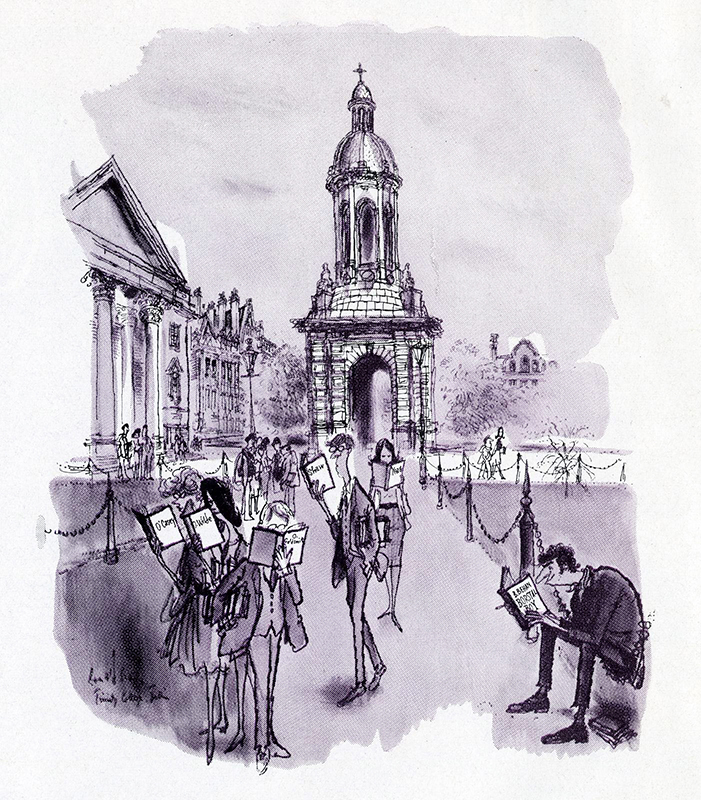
The Emerald Isle as seen through Searle's eyes.  Drawn in 1962 but published in 'Holiday' magazine April 1963.

'The human traffic on O'Connell Street, watched over by an angelic harp'.


At Trinity College this rebellious student reads Brendan Behan while the others are engrossed with Shaw, Wilde et al.


'Often, in Dublin, it is considered more sporting to loose your shirt than to keep it on.  Hence the popularity of horses.'

'Tears flow easy in a Dublin pub, but not even the heartbreaking songs from a brendanbehanish bard can truly water the beer.'


"It's Guinness!" O'Connell Bridge and the Liffey June 1962 (unpublished)

The Quays


Merrion Square


'Ireland is poor because it is infested by tricky thieves called leprechauns, who diligently hold up the exchequer in broad fairy light.  As greedy as their four-footed helpers, they bury their loot in crocks at the rainbow's end.'


'With his head not quite tucked underneath his arm, Dublin's logomachic chronicler, James Joyce, haunts the Martello tower at Sandycove.  As everyone recalls, the opening scene of his 783-page ulyssiad unravels here-a conversation of sorts between stately, plump Black Mulligan and moody, broody Stephen Dadalus.'
'The Antic Arts- Dublin's Lusty Theatre'

The drawing above recently sold at auction was not published as part of the article.


Searle illustrated this report by S. J. Perelman on 'the haunted manor of Poltrooney'.


Illustrations for 'In Quest of Beer' by Frank O'Connor
HOLIDAY magazine 1957 January


'Paris Folklore-Irish pubs all over' International Herald Tribune 15-16 March 1997
pg 24 'Green Power: the Irish Pub Invasion' by Mary Blume


Drawn for HOLIDAY but unpublished

Wednesday, August 01, 2012

Anatomies & Decapitations

After moving to Paris from London in 1961 Searle made a series of abstract expressionist works he titled 'Anatomies and Decapitations'. Of course it's impossible to speculate on the artist's state of mind but it was perhaps an effort to express the anguish over the situation he left behind -the decision to leave a faultered marriage with two children. The series could also have been a bid to achieve more respect from the art world as a 'serious' artist. It seems Searle wanted to be taken more seriously by the public and cultural arena after 15 years of  commercial success in England.  It's well known that Searle felt pigeon-holed at home and the 'Anatomies' could be seen as an attempt to re-invent himself.
UKJarry interprets the images thus: 'Largely unknown to the general public, Searle had been making extreme investigations into how far he could go in abstract representations of human beings. In 1962-63, he had worked on a series of ink and wash compositions he titled “Anatomies and Decapitations”. Exhibited in only a few galleries, they disturbed many of Searle’s firmest admirers and have never been published. They are the most abstract work Searle has ever done. 
They almost all either huge heads or a few distracted skeletal figures reminiscent of late period Picassos. Some are just splayed slashes of lines, others are circular or oval stains with blotches or sequences of scratches for features. A rejection of his apparently perfected professional style, they resemble nothing Searle had done before. Yet in each Searle is able to find a means of presenting a figure who looks beatific, moronic, anxious, prim, or explosive. It is tempting to detect the influence of Andre Francois in these works (as Francois’s work in“Punch” was a similarly intense influence on emerging graphic artists like Ralph Steadman, Gerald Scarfe, and Quentin Blake). 
In 1960, Searle’s Perpetua Press had published a collection of Francois’s work, “The Biting Eye”. Francois drawing style was scratchy, messy, blotchy. His deliberately rudimentary and scribbly figures were not the standard blocky cartoony figures. Despite being highly non-representative, Francois’s work captured something essential about humans and their behaviour. Likewise, “Anatomies and Decapitations” shows Searle discovering how he could convey complex emotions freed of the restraints of human particularity or the contexts of social customs. 

The first real product of these investigations intended for a popular audience was Searle’s Cats (1967). Searle had previously worked with animals, illustrating Geoffrey Willans’s The Dog’s Ear Book (1958), but those had been cartoonish animals, akin to the trotting figures of the Molesworth books, shaggy human actors in human situations with human responses. Searle’s cats would be much more abstract in composition. As Searle’s humans become less figuratively real, so he uses his cats to represent human states without relying on reductive realism. . . 
Devoid of any background, through the shape of the cats’ bodies and arrangement of the minimum of facial elements, Searle embodies mournful, complacent, persevering, avaricious, or aghast expressions to match his titles. Searle would later redraw many of the works in his first Cat book, but in the earliest edition, their origin in “Anatomies and Decapitations” is apparent. These were much messier creations in blobby inks, with rather splashy harsh gray washes like the blotchy faces of “Anatomies and Decapitations” spread out to occupy a theoretical cat-space with slashes for whiskers. . . 
The scenery of The Adventures of Baron Munchausen are typical of Searle but Searle’s figure of the Baron is an abstract bristling detonation of ink.For all that his facial features present a recognisable goggle-eyed, manic grinning buffoon, his body is an almost indecipherable sequence of blobs, dribbles, slashes and angles – yet evidently tightly conceived and executed since the figure is always consistently recognisable in each illustration.'
Searle confirmed to me that the style of 'Munchausen' was directly informed by the experimental 'Anatomies'
'In 1963, in New York's Bianchini Gallery, he launched a series of 73 ink, wash and watercolour 'Anatomies and Decapitations', anguished anatomical deconstructions never seen in Britain and still languishing in store.'    The Guardian 


'In 1962 he began work on his new satirical drawings, which were exhibited for the first time in the fall of 1963 in the Bianchini Gallery, New York. These ink-and-wash compositions, which are 291/8 X 20 1/2 inches in size and bear no titles, are the harvest of a long contemplative process: the mature commentary of an extremely sensitive observer upon human frailty in this day and age.'

Graphis magazine 109


Some of Searle's American audience viewed the series as a parade of Rorshach ink-blot tests, more suitable for psychological than artistic analysis, and it is true that difficulties with women are suggested by the occasional violence of the treatment.'    -Russell Davies
'
'Anatomies and Decapitations, premiered at the Bianchini Gallery, NYC, in October 1963, were never exhibited in England or collected in book form.  Over the previous couple of years, he had produced seventy-three of these large, disturbing explorations in ink, wash and watercolour, in which he was aiming to 'unmask' the human personality in a new way.'   -Russell Davies
'Some of his friends found the technique he adopted shocking, and stlll shake their heads over it. It is as if they feared the loss of control implicit in the runny textures, the sheet anatomical marshiness and capilloried bloat of these figures, which though evidently human - and even in odd cases mistakenly proud of it - look most alive when revelling in a sub-human grotesqueness. They are both dissolute and dissolving. Such frankly stated horrors of the body - the watery female body predominated in the collection - defeated many observers at the time. Graphis properly hailed the 'Anatomies' as 'un aspect nouveau de son art', but the accompanying essay by Ben Shahn, though eloquent, came in the nature of an endorsement of all Searle's gifts, rather than an excited reaction to this new form of comment. Perhaps even Searle himself was perplexed by what he had done.'   
-Russell Davies


'I know I am only on the fringe,' he wrote, when the exhibition was later transferred to Bremen, 'but for me it is the most exciting personal development in all the years I have spent exploring the medium of graphic art . . .It is the curse of the satirist that satire is basically a parasitical art-only thriving where there is weakness. The frailty of human character is the mushroom bed.' It seems a pity that these first fruits of his liberation from 'popular' fame did not meet a better fate'  
-Russell Davies


'The accompanying reproductions are a token of the large pen and wash drawings that have been done in the past year. I saw them in Paris last October and was completely set alight by them. The artist regards them as a culminating point of the years of exploring in graphic work from which they developed 'quite naturally and normally' (sic)! He says: 'I had been seeking a way of "anatomizing" the character and behaviour of people in our own curious and suspended times; after a period of fumbling I feel I am beginning to state a little of what those feelings are. 
'They are meant to be satirical and, in the best sense, rather uncompromising. As satire is basically a parasitical art- only thriving where there is weakness-the frailty of human character is my mushroom bed, or occasionally my mistletoe bough.' The artist's prose abounds in such visual imagery
.


'In some cases, the drawings could be described not so much as "anatomies" as "decapitations". Size has a good deal to do with the strength of these drawings. Their slightly monumental scale enables them to speak a little louder than some of my other work. But whatever they say - I still like people!'

G.S. Whittet 'The Studio' magazine


A much softer, colour feminine anatomy appeared in 'Carnet de Croquis' published in 1992


Thursday, January 14, 2010

The King's Breakfast


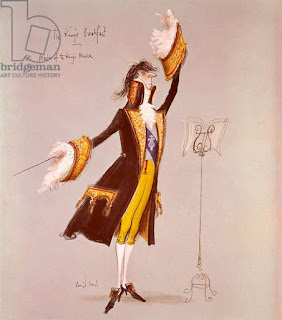
In 1963 Searle & Toye collaborated again on a short live-action film The King's Breakfast "a dramatisation in dance and mime, of the A.A. Milne poem about a king who had no butter for the royal slice of bread" (imdb)


The kitchen

The King's gym


 Maurice Denham as the King (thanks to Brian Sibley)

Yak El-Droubie sent in some wonderful shots taken by Douglas Webb on the set of The King's Breakfast. The sets, seemingly painted by Searle's hand, match his designs perfectly.  Like the 1954 Chelsea Arts Ball it's always a thrill to see Searle's work transferred into 'three dimensions'-imagine being on set in a 'walk-in' Searle painting!