Pages

Showing posts with label 1946. Show all posts

Friday, April 22, 2022

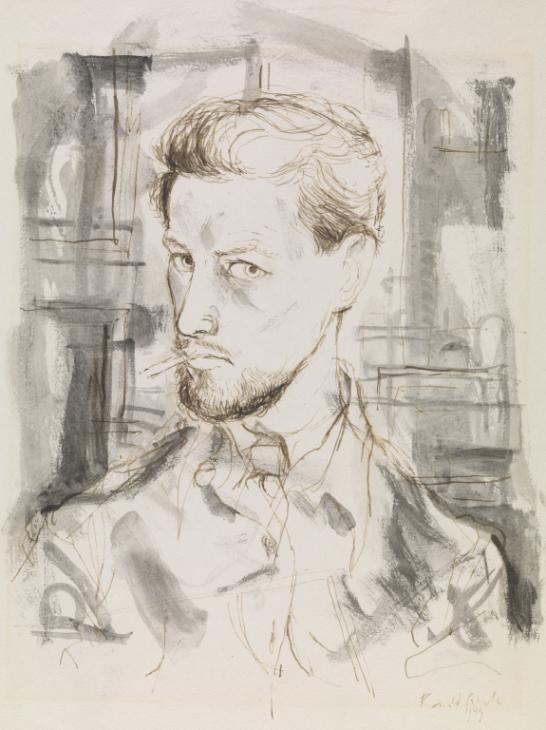
Early Searle


'Self Portrait' 1949 (Tate museum)


Photograph by Wolfgang Suschitzky, 1946

I'd love to identify the artwork on the easel; looks like a depiction of horses.

Saturday, April 04, 2015

Mirror & Echo

The UK National Archives online database has some early Searle cartoons here. The drawings are credited as having been published in the 'Mirror & Echo' and 'Blick in die Welt'. They are particularly interesting for their relevance to Searle's wartime experience and the culture he returned to after surviving incarceration as a POW of the Japanese.

The 'General Collapse' series would most certainly have been based on Searle's wartime experience. His POW 'gag' sketchbooks contain many sketches poking at the officer class and the clueless privates.


'Not having the tourist mind' is a light-hearted, series of tableau on a theme that Searle explored on other occasions throughout his career- the hapless tourist - most notably the 'Mrs. Dyson' series for Punch magazine in the late 1950s.


'German soldier and French couple in farmyard.'
Without his signature I struggle to authenticate this as Searle although it does bear some similarities to the style he employed for illustrations made for the Radio Times in the late forties.

'Do you hate the people you draw '
An early self caricature reflecting on the savagery of his cartooning.


 'Family bugbear'
This appears to be another self-caricature and, I would say, a representation of Searle's first wife Kaye Webb. Out of context it seems to depict domestic tension of some kind but it's hard to say without the accompanying article. To continue the self referential symbolism are the slanted eyes of the male figure a racist remark? Is it the smoking? Are those unpaid bills on the table?

Two pictures follow of certain dubious racial stereotypes and again it's hard to decipher the 'oriental man' leaving the house without his trousers!

'Oriental man leaving house Artist'

'Oriental man using chopsticks'


 'Mord in der Stube'


Illustration for Joyce Carey's Bush River


Wednesday, August 13, 2014

Lilliput pt.1

Lilliput magazine was a popular, pocket sized magazine of the 1940s-50s. Searle's work for the magazine fell into two styles; the broad cartoons of St. Trinians and the Patrick Campbell series; and more naturalistic illustrations accompanying short stories.

'Life in the Studio' 1946


These two studies are in the Victoria & Albert Museum, London.
Two sketches for 'Artist & Model' a cartoon for Lilliput magazine. Searle thoroughly explored the composition and forms of his figures before working up the final drawing. It looks like the first one was almost final then abandoned?

The same here: a study and a more worked up final but I'm not aware of them seeing publication in Lilliput.


October 1946
'"GIRLS, GIRLS! - A LITTLE LESS NOISE, PLEASE"' Lilliput, October 1946.
 Hurrah for St. Trinian's, London, 1948. 

January 1947 
'Cave!'
Lilliput, January 1947.
Hurrah for St. Trinian's, London, 1948, p. 57. 


March 1947


'The Place Where it Happened'
A Report by Honor Tracy
Lilliput magazine May 1949


'The Man-Eating Leopard of Rudraprayag'
A Short Story byJim Corbett
Lilliput magazine April-May 1951


'All Correct, Sir
A Short Story by Bill Naughton
Lilliput magazine May-June 1951

'Maisie was a Lady
A Short Story by Paul Vincent Carroll
Lilliput magazine June-July 1951

'Honesty's A Jewel'
A Short Story by Roderick Milton
Lilliput magazine Nov-Dec 1951


Searle only illustrated two covers for the magazine as far as I know.


Many of Searle's contemporaries worked for the magazine too; James Fitton, Anton, Walter Trier, Gerald Hoffnung et al. and it was well known as a compendium of the best of British illustration in the 1950s. Even the Disney animators were familiar with it and an hommage found its way into 'One Hundred & One Dalmations' (1961), perhaps a tacit admission from a film which stylized its art direction directly after Searle's work.


Searle's artwork was so ubiquitous during this era that even in an issue absent of Searle's editorial illustrations there would still be advertisements illustrated by him.


See my Lilliput blog for more. . .