Showing posts with label 1951. Show all posts
Showing posts with label 1951. Show all posts
Monday, August 27, 2018
Diverting History
In 1951 Searle collaborated with UK animation studio Halas & Batchelor to create a film version of William Cowper's story 'The Diverting History of John Gilpin'. British readers can now view the film at this link.
 The drawings were later released in an illustrated edition. See them here

Monday, September 12, 2016
The best of St. Trinians
Back to school with the best of St. Trinians . . .

'EUNICE! HOW MANY TIMES MUST I TELL YOU TAKE THE BAND OFF FIRST!'
LILLIPUT, APRIL 1951
(RONALD SEARLE, BACK TO THE SLAUGHTERHOUSE AND OTHER
UGLY MOMENTS, LONDON: MACDONALD, 1951, PAGE 50;
RONALD SEARLE, THE CURSE OF ST TRINIAN'S, LONDON:
PAVILION BOOKS, 1993, PAGE 49
EXHIBITED: 'THE ILLUSTRATORS. THE BRITISH ART OF ILLUSTRATION 1837-2015',
NOVEMBER 2015 - JANUARY 2016, NO 361)
(RONALD SEARLE, BACK TO THE SLAUGHTERHOUSE AND OTHER
UGLY MOMENTS, LONDON: MACDONALD, 1951, PAGE 50;
RONALD SEARLE, THE CURSE OF ST TRINIAN'S, LONDON:
PAVILION BOOKS, 1993, PAGE 49
EXHIBITED: 'THE ILLUSTRATORS. THE BRITISH ART OF ILLUSTRATION 1837-2015',
NOVEMBER 2015 - JANUARY 2016, NO 361)

'Eunice, dear- aren't we rather muddling our patron saints?'

"And this is Rachel - our Head Girl"

"But Miss Merryweather, you said we could bring our pets back with us"
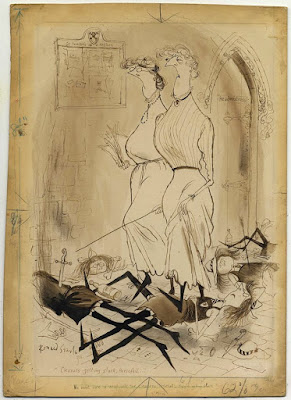
"Cleaner's getting slack. Horsefall . . ."
(Lilliput 1952 Oct/Nov)
 "... and a pair of knuckledusters, and some scent, and a hammer ..."
(Lilliput 1951 6 Nov)

'Parents' Day'
(Lilliput NOVEMBER-DECEMBER 1951, PAGE 39

"Cleaner's getting slack. Horsefall . . ."
(Lilliput 1952 Oct/Nov)

(Lilliput 1951 6 Nov)

'Parents' Day'
(Lilliput NOVEMBER-DECEMBER 1951, PAGE 39
Saturday, March 26, 2016
Morocco

'We saw our first yashmak in Tangier; the international port where taxes are low and a ten-roomed house sells for 15,000 pounds.
The Arab shop in the souk (bazaar) burst with Swiss watches, French perfume and American shirts, nylons, watches and fountain pens. Great Britain is represented by chocolate and sewing machines.
In Tangiers' market place, the country-women from the Spanish zone, their babies tied to their backs underneath shapeless white haiks, sell flowers, vegetables, much-handled bread and sweetmeats. The men, bearded and turbaned, gather entranced as children round the story-tellers on the square.
The narrow streets are bursting with boot-blacks, vendors, begging children, pickpockets and donkeys so loaded that we cram into noisome doorways to let them go past. . .

'In Fez the Arabs retain their dignity and their privacy in their thousand-year old walled city. Tourists gape at the wonderful golden marriage belts, the elaborately ugly copper bowls, the tooled leather blotters and admire the pretty, friendly children. They have no way of guessing that they are ridden with tuberculosis. . .


In Marrakesh, El Giaoui's country, the people are gayer, lazier, more corrupt. The white clothes are replaced by brilliant jellabahs. There are more bicycles than donkeys and the famous Place Djemaa el Fna is teeming with snake charmers, musicians, dancers and storytellers from breakfast time until nearly midnight. At sunset their their noise reaches a crescendo and drowns the voice calling the faithful to prayer from the nearby mosque - and we never saw any of the audience turn towards Mecca.'

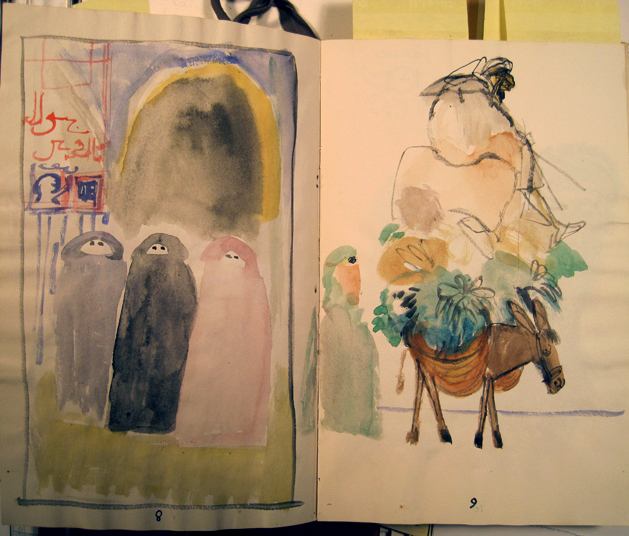
In 1965 Searle returned for a reportage assignment to capture in drawings Casablanca for HOLIDAY magazine. The format allowed him to use colour and a couple of the pictures he made even drop his trademark linework in favour of impressionistic swatches of colour. These pictures are among my favourite of Searle's ouvre. We can see how is style has developed over the intervening 14 years.
On one visit to Searle's studio he permitted me to photograph the original sketchbook he kept on the '65 trip to Morocco and I present them here with the corresponding finished pictures (which were not all published by Holiday).




Sources:
Wilhelm Busch - Deutsches Museum für Karikatur und Zeichenkunst
Holiday Magazine,
Uli Meyer,
British Library,
News Chronicle
Ronald Searle
Wednesday, August 13, 2014
Lilliput pt.1
Lilliput magazine was a popular, pocket sized magazine of the 1940s-50s. Searle's work for the magazine fell into two styles; the broad cartoons of St. Trinians and the Patrick Campbell series; and more naturalistic illustrations accompanying short stories.


 Two sketches for 'Artist & Model' a cartoon for Lilliput magazine. Searle thoroughly explored the composition and forms of his figures before working up the final drawing. It looks like the first one was almost final then abandoned?
 The same here: a study and a more worked up final but I'm not aware of them seeing publication in Lilliput.


Searle only illustrated two covers for the magazine as far as I know.


Many of Searle's contemporaries worked for the magazine too; James Fitton, Anton, Walter Trier, Gerald Hoffnung et al. and it was well known as a compendium of the best of British illustration in the 1950s. Even the Disney animators were familiar with it and an hommage found its way into 'One Hundred & One Dalmations' (1961), perhaps a tacit admission from a film which stylized its art direction directly after Searle's work.

Searle's artwork was so ubiquitous during this era that even in an issue absent of Searle's editorial illustrations there would still be advertisements illustrated by him.

See my Lilliput blog for more. . .
'Life in the Studio' 1946
These two studies are in the Victoria & Albert Museum, London.
October 1946
'"GIRLS, GIRLS! - A LITTLE LESS NOISE, PLEASE"' Lilliput, October 1946.
Hurrah for St. Trinian's, London, 1948.
Hurrah for St. Trinian's, London, 1948.
January 1947
'Cave!'
Lilliput, January 1947.
Lilliput, January 1947.
Hurrah for St. Trinian's, London, 1948, p. 57.
March 1947
'The Place Where it Happened'
A Report by Honor Tracy
Lilliput magazine May 1949
'The Man-Eating Leopard of Rudraprayag'
A Short Story byJim Corbett
Lilliput magazine April-May 1951
'All Correct, Sir
A Short Story by Bill Naughton
Lilliput magazine May-June 1951
'Maisie was a Lady
A Short Story by Paul Vincent Carroll
Lilliput magazine June-July 1951
'Honesty's A Jewel'
A Short Story by Roderick Milton
Lilliput magazine Nov-Dec 1951
Searle only illustrated two covers for the magazine as far as I know.
Many of Searle's contemporaries worked for the magazine too; James Fitton, Anton, Walter Trier, Gerald Hoffnung et al. and it was well known as a compendium of the best of British illustration in the 1950s. Even the Disney animators were familiar with it and an hommage found its way into 'One Hundred & One Dalmations' (1961), perhaps a tacit admission from a film which stylized its art direction directly after Searle's work.
Searle's artwork was so ubiquitous during this era that even in an issue absent of Searle's editorial illustrations there would still be advertisements illustrated by him.
See my Lilliput blog for more. . .
Subscribe to:
Posts (Atom)