Pages

Showing posts with label 1953. Show all posts

Wednesday, October 04, 2017

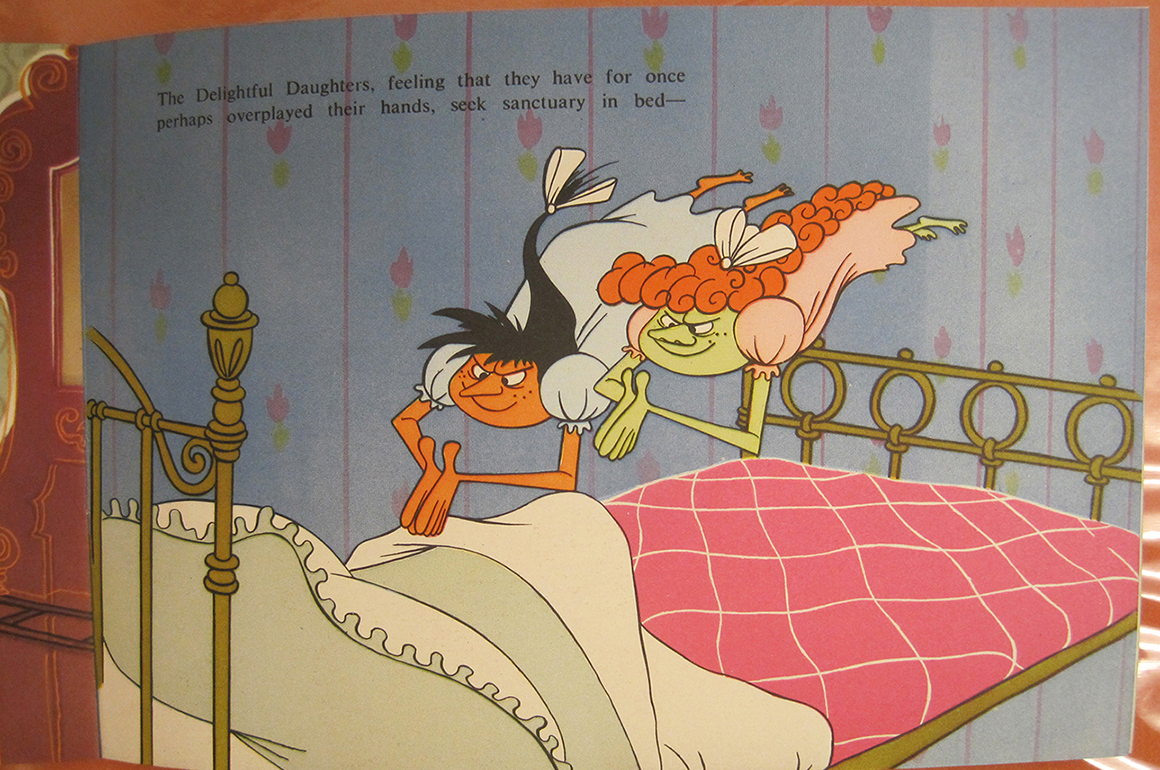
A rare' Searle-designed' animated film for 'Lemon Hart Rum' screens this weekend at the BFI in London. Details & tickets here.

The 3 minute film was produced by Larkin Studio in 1953. Music by Francis Chagrin. Art direction by Phil Windebank.


The short film was shown in UK cinemas and a printed booklet featuring art from the film was distributed at screenings. A copy exists in the Searle Archive in Hanover, Germany. 


More on Lemon Hart Rum here


See a stop-motion Searle style ad for 'Lemon Hart Rum' here

Wednesday, March 05, 2014

Italy, Max Beerbohm & Exhibitions


Ronald Searle first visited Italy in 1949 with his wife Kaye. They explored Portofino and Rapallo where they looked up humourist and caricaturist Max Beerbohm.
'In October, the Searles visited Italy and stayed with their friend Jennie Nicholson (daughter of Robert Graves) in Portofino, and she had taken them along the coast to Rapallo to meet the venerable Max. 'I have a little talent,' he explained to Ronald, 'but I have used it well.' Ronald was hardly neglecting his own; in Portofino he completed no fewer than ten paintings that were exhibited at Wolf Mankowitz's Little Gallery immediately on his return'  (Russell Davies)


In 'Conversations with Max' S. N. Behrman  (The New Yorker March 12, 1960) relates finding a Searle portrait of Beerbohm. 
 ". . . She put the great book on a table beside me. "I thought you might want to look at this—the Festschrift volume of tributes given to Max by his friends and admirers to commemorate his eightieth birthday. I think you will enjoy it. But first you must take a nap. First you must rest."
 I said I would try. "I'll call you for tea," she said. Miss Jungmann was gone. I was tired. I stretched out on the sofa, but I found I couldn't sleep. I opened the great Festschrift volume. The first thing that greeted my eye was a superb full-page colored drawing of Max by Ronald Searle, the Punch cartoonist. It shows Max in a toga, with a laurel wreath on his head, at a rakish angle—the same angle at which he habitually set his straw hat. 


Max was the only man in the world, I thought, who could look rakish in a laurel wreath, and Ronald Searle perhaps the only man who could make him do it. Max's arms are bare, and, anachronistically, he is smoking a cigarette in a long holder. He looks infinitely bored, presumably at the echoing plaudits that, around the civilized world, greeted his eightieth birthday. The caption beneath the drawing reads, "Max Accepts with Resignation His Place Among the Classics."
The Searles' charm won Beerbohm over and he was persuaded to pen the preface to Ronald's second book of collected cartoons 'The Female Approach'.


In 1953 Searle revisited Italy to recharge his creative batteries. He wanted to see Renaissance artworks and sketch the people and countryside. He actually made two trips that year travelling the length of the country from Milan to Sicily. The resulting drawings show a different, surprising side to the artist and were exhibited and sold at the Leicester Galleries, London the next year.  In his biography of Searle Russell Davies writes:


'A pleasant consequence of his high professional standing was that Searle could now award himself the occasional break from his pattern of work. Already widely travelled in places where few tourists would be terribly eager to go, he had so far never had the chance to immerse himself, alone, in the splendours of Renaissance art. In 1953 he put this right. His first trip, in midsummer, was devoted to resting and looking. . . In Milan, the itinerary began propitiously with time spent in the company of Giacomo Manzu, the sculptor and lithographer. . . Rome, Naples, Capri and Pompeii followed; Sienna, in time for the Palio; and the great binge of Florence, taken far too quickly, of course, but as an investment of information for the return visit. Searle enjoyed his solitary wandering, though it left him open to rather haunting experiences like the one that occurred in the Grand Hotel in Milan. He made an immediate note of it:

"The little waiter who brings me my breakfast - a sad, grey, little man with sunken cheeks and pink rims to his eyes - just brought in some coffee 'for a nightcap'. He hesitated a moment and, slightly embarassed, said: "Scuse medonta mind, but why do you use your left hand to write? I saw for the furst time this morning that you usa left hand and I look to see whata wrong with the other, but it looka alright to me. I never see it before, except once with a soldier who had the other one offa here' - sawing at his shoulder. I told him I was born left-handed and it was fairly commonplace in England. 'Well,' he said, 'I never see it before.' (He must be 50.) Surely left-handedness can't be so rare in Italy - or peculiar to England. Anyway I seem to recall that Leonardo was left-handed. The waiter went out quite convinced that it was rare and strange - still puzzled that it should happen."
 
It was the waiter who now seemed rare and strange: was this some complicated defence on his part against the superstitions that still attached to the left-hander, or mancino, in Italy? Happily, Leonardo's 'Last Supper' was close by for reassurance. . .

'Milan'
 '. . . the second Italian trip came round. This time the whole of October and November were allotted to the journey, which took Searle from Milan right down, through a month's discouragingly awful weather, to Taormina in Sicily, where his 'enormous sketch-block' finally came into its own. At one point Ronald's activities became so intimately intertwined with those of the local fisherman that he used 'the fresh black ink of a newly-caught cuttlefish to sketch the head of one of the men who caight it'. To return to such basics of existence, and to the improvisatory methods of his imprisonment, must have reminded him of the dangers of an over-civilization of his talent. He was entering again intot the spirit of exile. His many paintings of Sicily, mostly sold at the Leicester Galleries in 1954 in an exhibition with the no-nonsense title of 'London, Taormina - and the last of the schoolgirls', were watercolours and gouaches; it would take ten years, Searle said, to master oils, and no time would be left for anything else.' (Russell Davies)


'The look of these paintings was quite 'hot': complex and jungly lines made legible with bold colour. Sometimes one misses the human figure; a preparation seems to have been made for a foreground actionthat does not occur. Perhaps the artist felt this too; it is certainly a problem he could have wrestled with. As his friends have said of him, it was 'another way he could have gone'. But instead, in December, he went home to his contracts and agreements and responsibilities.' (Russell Davies)


'Isola Bella, Taormina, 1953'


A contemporary review of the exhibition in the Spectator (15 Oct 1954) by M. H. Middleton critiqued Searle's new direction:

'I HAVE been wondering this week whether Ronald Searle is not the best comic draughts- man we have had in this country since Rowlandson. I dismiss from this context the Keenes and the Mays, and all those forced by their period to work within a literary framework in which the savagery of the caricature tradition is relaxed to a point where it practically ceases to exist. Who else is there? Searle's wit, as Rowlandson's, is in his line. -Rowlandson's typical line is the half-ellipse, and it conveys a fat, eighteenth- century chuckle; Searle's is the sharp, angular arrow-head, and it conveys a note of twentieth-century cruelty and hysteria. Ho is completely of our day. The pin-stripe trousers of his business men taper as ele- gantly as the legs of any contemporary chair; their triangular noses are as abstract as the tree-forms of Alan Reynolds or the metal sculptures of Lynn Chadwick; the phenomenal world is dislocated as surely as by any surrealist.
Here the ridiculous shades into the sinister. This is a world in which fairies get stuck to the flypaper; in which bearded myopics pay court to seductive female masks; in which eyes come of with the spectacles in front of them and feet are put outside the hotel bedroom to be cleaned. Herein perhaps lies a danger. If the comic draughts- man's particular brand of expressionism is not to degenerate into a habit, his characters into types, he must constantly be replenishing his stock by fresh observation. Ronald Searle's new exhibition at the Leicester Galleries shows him moving away from a central position, on the one hand to topo-graphical and portrait records, on the other to the invented visual fantasy largely created by Steinberg. When Steinberg's Italian in front of San Marco waves his hands in the air to describe the female form divine, and leaves her curves there in dotted line, he seems to be opening up a new dimension in comic drawing—but it is still one based, in the last analysis, upon observation. I hope Searle never strays too far from the real world, because I suspect that the quickness of his eye and the easy facility of his pen may in fact outlast his invention, and it will be a pity if their marriage should break up.'

CATALOGUE OF THE LIBRARY AND LITERARY MANUSCRIPTS OF THE LATE SIR MAX BEERBOHM.

(Beerbohm, Max).

  • London: Messrs. Sotheby & Co. 1960.
- See more at: http://www.oakknoll.com/pages/books/15210/catalogue-of-the-library-and-literary-manuscripts-of-the-late-sir-max-beerbohm#sthash.voRD0IsA.dpuf

CATALOGUE OF THE LIBRARY AND LITERARY MANUSCRIPTS OF THE LATE SIR MAX BEERBOHM.

(Beerbohm, Max).

  • London: Messrs. Sotheby & Co. 1960.
- See more at: http://www.oakknoll.com/pages/books/15210/catalogue-of-the-library-and-literary-manuscripts-of-the-late-sir-max-beerbohm#sthash.voRD0IsA.dpuf

In an article entitled 'Strictly Not St. Trinian's' The Sketch magazine was more complimentary: 'The pictures on this page . . . were painted in the autumn of last year during a holiday in Taormina, with the exception of the clerical gentlemen, which was made in Rome. . . This last painting holiday in Italy is typical of his method of work. The experience comes first. In June and July, he painted nothing, but soaked in the sun, and visited museums and art galleries; his taste is catholic. Then he returned to Italy in September, spent a month dismally in bad weather, and began, in November, to wander about the place with an enormous sketch-block. . . he works in water-colour, gouache - in anything but oils.'


Searle later drew the Duomo in Milan for Fortune magazine 1962


Sources:

As always Russell Davies' invaluable Searle biography

Max Beerbohm's Mischievous Wit: A Literary Entertainment By Jacobus Gerhardus Riewald
The Sketch magazine 1954
The Searle Archive, Museum of Karikatur, Hanover, Germany 

In 'Conversations with Max' S. N. Behrman (The New Yorker March 12, 1960)

Tuesday, July 17, 2012

The Alexander Technique

Frederick Matthias Alexander (20 January 1869 – 10 October 1955) was an Australian actor who developed the educational process that is today called the Alexander Technique – a form of education that is applied to recognize and overcome reactive, habitual limitations in movement and thinking.
(Wikipedia)

Searle inscribed his portrait of Alexander "from the reconstituted artist, with thanks"-presumably alluding to the health problems incurred as a prisoner of the Japanese during WWII.  Ronald was asthmatic, smoked for years and had throat surgery late in life so perhaps Alexander's theories on respiration helped him?


'He teaches the way back to Health'


Half a century ago a hansom cab arrived in great haste at a house in Ashley Place, Victoria.  The driver had instructions from Sir Henry Irving to "fetch Mr. Alexander to the theatre immediately" as he was in need of help.
More than 25 years later George Bernard Shaw crept up the same steps suffering from angina.  (After three weeks he was again taking his jaunty way to the club for his morning swim!)
Some years before the war a newspaper report of an all-night sitting in the House of Lords ended by stating that at "4am the only person sitting up straight was the Earl of Lytton."  The next morning Lord Lytton sent the cutting to "F.M. with thanks."
There are enough of these stories, studded with illustrious names, to fill a book, but it wouldn't give frederick Matthias Alexander very much pleasure.
For he dislikes any suggestions that he is a healer, or a miracle man.  The statement that he 'cures' makes him angry and he accepts no patients, only 'pupils'.  He is, he says, an educator.
For sixty years he has been trying to pass on to mankind the lessons he has learnt on hos own body-discoveries which caused the American philosopher Professor JohnDewey to write, "It is a revolution in thought and action".

Ronald Searle & Kaye Webb quoted in The Alexander Technique As I See It By Patrick MacDonald-probably originally part of their 'People Worth Meeting' column for the Saturday News Chronicle (but not included in Looking At London)

Francesca Greenoak wrote this profile of Searle for the Alexander Journal in 2010.


This article was first published in the Alexander Journal 23, republished here with the kind permission of the Society of Teachers of the Alexander Technique (STAT).

Friday, June 29, 2012

S. J. Perelman

American humourist and author Sidney Joseph Perlman had a well known creative partnership with cartoonist Al Hirschfeld.  Their Westward Ha! (1948) was an early example of an illustrated travelogue, matching a satirical writer with an illustrator of a similar sensibility.  Their globe-trotting trip was paid for by Holiday magazine and initially published as a series in the magazine.


Less known is Perelman's collaboration with Ronald Searle. Like Perelman and Hirschfeld Searle had found success illustrating the satirical travelogues of Alex Atkinson published in Punch then later Holiday.
Punch editor Malcom Muggeridge introduced them in London in the early fifties and it seems they instantly clicked, remaining friends for the rest of their lives. 'Perelman had his irascible side. . . but he had a genuine affection for Ronald, triggered at an early meeting when the Enlishman asked his way to 'the cloakroom', a term which delighted Sid by transporting him instantly to his favourite literary territory, amid the rapiers and intrigues of Baroness Orczy.' (-Russell Davies)

'. . . we all went off to a party at Ronald Searle's. . . oddly enough this was practically a counterpart of an evening at the Hirschfelds', made even more uncanny by Searle's having a beard.  They live in a four-floor modernische house in Bayswater, top floor of which is his studio, like Al's.  It was one of those progressive parties, where waves of people had been piling up since five o'clock and it was now ten-thirty . . . a real bedlam.  Finally, though, Searle and I got a few minutes alone in his studio, inscribed books to each other, and had a short interval of sense.  He's an extremely talented man, as you know, and among other things I learned that he first learned to draw when he was a prisoner on the Burma-Siam frontier in a Japanese camp, being the only man in his company who ever got out alive . . . '
(Letter from Perelman to his wife Laura Dec 23rd 1953)

Peter Harrington Books is selling a 1st Edition copy of Westward Ha! inscribed to Searle by both Perelman and Hirschfeld in 1953. It's likely this is the book signed by Perelman for Searle in his loft studio in 1953. It's nice to see the esteem held by Hirschfeld for his fellow caroonist in this dedication.
Also, a copy of Perelman's 'The Beauty Part' (1963) 'Inscribed by the author to his friend and collaborator Ronald Searle on the front free endpaper, "For Monica and Ronald, this obstreporous [sic] vaudeville with love from its author, Sid. 14 February, 1968". Includes, loosely inserted, an envelope dated Feb 12 1986 to Searle from Perelman containing an autograph letter giving directions to the appropriate bus stop to reach him in his country residence in Frenchtown, New Jersey, and a bus schedule. A charming artefact of a close friendship.'


'Dear Ronnie, I must tell you at once how pleased I was to receive the books you sent us, Take One Toad and The Square Egg.  Take One Toad is a strikingly original job, I was much impressed with the way you handled the period costumes and the whole conception of the book.  This is not to downgradeThe Square Egg in any sense; you have some marvelous drawings in that, it goes without saying.  The first one, naturally, has a unity that the other as a collection doesn't.  At any rate, here's hoping that The Square Egg has more than the modest sale you foresaw in your note to me. . . 
(Letter from Perelman to Ronald Searle December 10th, 1968)

Searle's caricature of Perelman looks like an evolution of Mr. Lemon Hart in turn inspired by lanky Punch theatre columnist Eric Keown.


'My Life In Scotland Yard' Holiday Magazine April 1968
"It was piquant to learn that I resembled Dr. Crippen, the classic poisoner."
"The subject was murdered by renowned ghouls and I rather wanted to lie down"
"The Black Museum piece was tip-top, you caught every sinister possible facet"
(Letter from Perelman to Ronald & Monica Searle April 8th, 1968)


"The law was guilty of an anatomical booboo"

'Room and Bored' in haunted Irish manor Poltrooney
Holiday Magazine September

Following the decline of Holiday magazine Searle and Perelman sustained their collaboration in the pages of Travel & Leisure magazine, probably commissioned by Holiday's ex-Art Director Frank Zachary who had jumped to the new title. Searle provided lavish illustrations to compliment Perlman's equally exotic travel series 'Nostasia in Asia'.  I have the first in the series but if anyone has the rest please contact me at the email address in my Blogger profile.
'Dear Ronnie. . . thank you very much indeed for your drawing of myself being inducted into the Chinese tailor shop in Hong Kong that illustrated the fourth piece in that Travel & Leisure series.  As soon as it's framed, it goes up on the wall. . . it'll make a peachy companion pice to one of Andre (Francois)'s covers for The New Yorker, a cafe scene he did a couple years ago; and it will also be cheek by jowl with that marvelous photograph of Toulouse-Lautrec you once gave me.'
(Letter from Perelman to Ronald Searle November 4th, 1974)


A tropical encounter with W. Somerset Maugham

2. The Egg and Ainu 


3. Paradise-once over lightly


Perelman wrote the introduction to a Searle illustrated  'The Adventures of Baron Munchausen', published in 1969.  The adventures of the mustachioed  weaver of tall tales seems to perfectly portray Perelman himself!


I remember the Searles telling me over lunch of a spooky incident involving Perelman's death-in his biography of Searle, Russell Davies quotes Ronald:

'Suddenly an old friend appeared before, looking like a gently spotlit figure on a stage. . . Only one finger moved, to tap ash from an ashless cigarette. (She always tapped more than she smoked.)  The apparition was Laura West Perelman. . . she had died in 1970.
But here she was, nearly ten years later, very much alive and looking me straight in the eye.  With her usual laconic American drawl, she spoke, coming directly to the point as usual:
'RAHnald, Sid's dead,' she said. Then she was no longer there.
In the morning, before I had even got to my coffee, the telephone rang. My sister-in-law was calling from London.
'Sad news, I'm afraid.  I've just heard on the radio that Sid Perelman has been found dead in his hotel room in New York . . . '
Sid had died at the Gramercy Park Hotel during the night of the 16-17 October.  Searle describes this as 'a very small ghost story: but it certainly impressed me at the time'.  He still awaits Sid's explanation.'

'I Dreamt that I dwelt in Marble Halls'
Holiday Magazine September 1968


An amusing letter between the cartoonist and his friend the humourist Sid Perelman. Searle THANKS Perelman for sending him his newly published Omnibus, "what a marvellous surprise for the Searles who send their warmest thanks not only for the modest inscription but also for momentarily assuaging their ever greedt appetite for SJP".  

Searle adds a PS on the back of THE PAGE discussing a hat that Perelman had in a glass case. "I've been worried for a long time about that hat in the glass case" [small drawing of hat]. Searle goes on to explain that it reminded him of a hat in the Hans Andersen museum beside which was a length of rope which Andersen "carried everywhere in case of fire. How anticipatory can you get? Perhaps yours needs a small extinguisher."


(Letter for sale -Sotherans)


From Facebook:


Sources:
Russell Davies' biography of Ronald Searle  
Dorothy Hermann's biography of S. J. Perelman
'Don't Tread On Me' Selected Letters of S. J. Perelman
Holiday Magazine1968
Travel & Leisure Magazine 1973
(Thanks to Josh Lieberman for contributing scans)