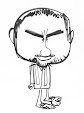
Royal Institute of British Architects
During the early 50s Searle and his first wife Kaye Webb moved into a modernist home designed by architect
Denys Lasdun. In a style influenced by the early 'domino principle' villas of
Le Corbusier, Lasdun built the house on his own in his mid twenties.
It was an ostentatious home befitting the profile of a young, successful and increasingly well known couple. Searle's top floor studio had plenty of light and Kaye frequently threw parties for London's cultural community. For example, as in the last post, this would've been where S.J. Perelman first met Ronald.
At their previous address on Moscow Road Searle had been walking every day to his studio space at 77 Bedford Gardens but here the family could all be under one roof.
Completed in 1938 the house at 32 Newton Road, just off Westbourne Grove was 'one of the first houses carried out in an absolutely uncompromising contemporary manner'.
'Built for a pair of bachelor artists, it was topped by a splendid studio favoured by north light, as the estate agents say, and a fine terrace overlooking half of Paddington. As Searle remarked to his friend David Arkell, 'If one had to overlook half of Paddington, this was the way to do it.'
(Russell Davies)
Searle portrayed Lasdun for his 1953 book
'Looking At London'
The book also features a view from the back terrace of 32 Newton Rd with the hands of the Searles visible in the foreground; author and artist of the publication.
'Newton Road was not turning out to be a complete success. Filled with gorgeously multifarious objets and the light admitted by vast horizontal windows, and even a wall of glass bricks in the hall, the house was ideal as a photographic backdrop for visiting cameramen.
The Searles had many friends in journalism and underwent the 'ideal couple' treatment more often than most. Their New Year Party came to be quite a celebrated event in the social calendar of London's artists, writers and performers during the 50s. There are those who, with hindsight, remember these gatherings as 'entirely Kaye's thing', with Ronald a rather withdrawn and even embarassed presence.
Others recall him as a perfectly willing accomplice. The truth is that he was probably just tired. Invitations and decorations were all his responsibility, and he could not bear to fall short of personalizing all the items so that everyone had something to take away.
But it was in the normal working day that the inadequacies of the house really showed themselves. Sound travelled unobstructed-a switch turned on in the cellar could be heard at the top of the house-and the twins' playroom was directly beneath Ronald's studio. Ronald would be trying to work, it seemed to Paul Hogarth, 'while the twins were fighting with T-squares'.
Ronald's own preference was for a radio turned on very low, and meticulous tidiness, an aim in which none of the rest of the household was able to match him.
The house itself was famous-architectural-school pilgrims came in busloads to see it- and so was Ronald; the visiting graphics world seemed to expect him him to act as its host. Nobody, not even the artist friends to whom he mentioned the problem, realized how seriously he wished to insist on his privacy.' (Russell Davies)
'Ronald's routine was to walk to his studio each morning, returning for an early supper at Burnham Court, before leaving to meet Punch's critic Eric Keown for their work at the theatre. But the winter of 1951 had been 'harder and more miserable than any I have known,' Kaye told her father. The time had come to consolidate family life and studio in one place, so a search began.
'We were on our knees with pounding around Paddington and Bayswater for weeks' Ronald recalled. The trek brought to a unique house in Bayswater, 32 newton Road, built in an uncompromisingly contemporary steel-and-concrete style. 'As soon as we went through the front gate we fell in love with with the house- as odd as it seemed in a street of early Victorian villas,' Ronald says. It had been designed in 1938 for two bachelor artists, 'unknown artistically, but extremely wealthy' (the sculptor Robert Conway and his friend), by the young architect Denys Lasdun. There was a vast studio on top, where Ronald could work, with a north light and fine terrace.
The wall by the front door was of glass bricks; upstairs was a thirty-foot stretch of plate-glass window. The cellar was full of stuff left by the previous owners (including several Lucian Freuds, which they returned).
'The only problem was we had no money,' Ronald recalled. 'Well, just about enough to put down the deposit. The price was unbelievably expensive for a couple of freelancers at that time' (it was £7,000), 'and the banks felt that it was an unsaleable modern horror-pity that it had no Elizabethan timber on the façade, or something.' Eventually they got a £5,000 mortgage from Lloyds Bank, Notting Hill Gate, at 4.5 percent. . . 'and we did manage to pay it off, by agreeing to perpetrate untold rubbish over the years,' Ronald told me. 'It turned out to be perfect for all our working space and living needs.'

'. . . Domestic life in the 1950s was simple. Entertaining was rarely lavish, decor was unexciting. So the Searles' distinctive home was much written about. ('Their marriage is a model of domestic happiness enriched by professional collaboration,' wrote the Sunday Times's Atticus.) Unusual objets trouvés were displayed everywhere - a Webb toy theatre, a model of an old steam engine, a rocking-horse, a row of marionettes, a ladder painted with stars and diamonds, an American wall clock with an enormous winking eye painted by Ronald on its pendulum.

The curved fireplace wall was hung with Japanese masks, costumed dolls, prints and drawings, and plastered with invitation cards. There was imaginative use of colour, even on radiators. Their bedroom was lime-green and maroon. The back door was candy-striped in pale blue and white, with sunbursts of of yellow and black. The bathroom had curtains of striped towelling. . . Ronald had even painted the light-switches: one was disguised as an eye with heavily fringed lashes and an arched eyebrow; another had a cow's head with switches in eye and nostril; another had a bird perched on it. Any corner was embellished with a mural-a simpering mermaid brandishing a frying pan and a fork; a tricorn-hatted military figure with twirling moustache, on a bicycle.
Photo by Madame Yevonde
Ronald's sprawling studio on the top floor had a sky-blue ceiling, its white walls covered in drawings and posters, shelves of art books, with concealed lighting, and a Berber rug on the parquet floor. The crimson and white striped curtains were of deckchair canvas. The playroom had one wall coated in blackboard paint, and a glass-topped table displayed the children's paintings.

(from
'So Much To Tell' Valerie Grove's biography of Kaye Webb published in 2010 by Viking)
If you look at the house on Google Street View you can observe just what a modern design it was for that street.
© Yevonde Portrait
Explore this building
here