Pages

Showing posts with label 1965. Show all posts

Saturday, March 26, 2016

Morocco

Searle first visited Morocco in March 1951 and a handful of the sketches he made were published in the broadsheet News Chronicle March 28th. I believe he was traveling with his first wife Kaye Webb and it is probably she who penned the accompanying dispatch (as she did for their reports on London for the same publication).


'We saw our first  yashmak in Tangier; the international port where taxes are low and a ten-roomed house sells for 15,000 pounds.
The Arab shop in the souk (bazaar) burst with Swiss watches, French perfume and American shirts, nylons, watches and fountain pens. Great Britain is represented by chocolate and sewing machines.
In Tangiers' market place, the country-women from the Spanish zone, their babies tied to their backs underneath shapeless white haiks, sell flowers, vegetables, much-handled bread and sweetmeats. The men, bearded and turbaned, gather entranced as children round the story-tellers on the square.
The narrow streets are bursting with boot-blacks, vendors, begging children, pickpockets and donkeys so loaded that we cram into noisome doorways to let them go past. . .

'In Fez the Arabs retain their dignity and their privacy in their thousand-year old walled city. Tourists gape at the wonderful golden marriage belts, the elaborately ugly copper bowls, the tooled leather blotters and admire the pretty, friendly children. They have no way of guessing that they are ridden with tuberculosis. . .


In Marrakesh, El Giaoui's country, the people are gayer, lazier, more corrupt. The white clothes are replaced by brilliant jellabahs. There are more bicycles than donkeys and the famous Place Djemaa el Fna is teeming with snake charmers, musicians, dancers and storytellers from breakfast time until nearly midnight. At sunset their their noise reaches a crescendo and drowns the voice calling the faithful to prayer from the nearby mosque - and we never saw any of the audience turn towards Mecca.'

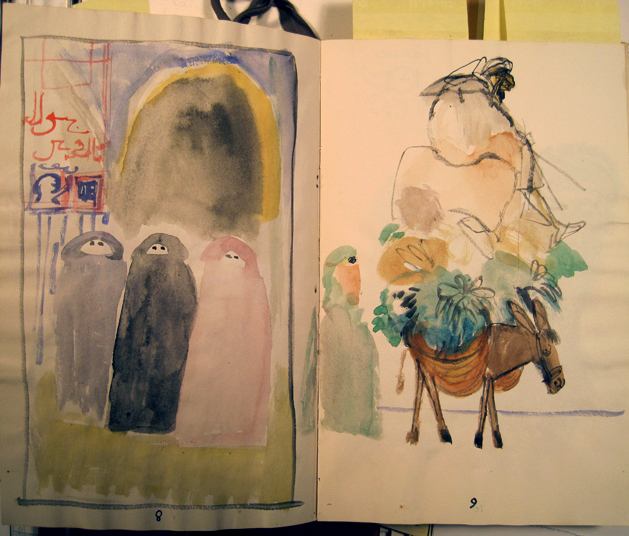
In 1965 Searle returned for a reportage assignment to capture in drawings Casablanca for HOLIDAY magazine. The format allowed him to use colour and a couple of the pictures he made even drop his trademark linework in favour of impressionistic swatches of colour. These pictures are among my favourite of Searle's ouvre. We can see how is style has developed over the intervening 14 years.
On one visit to Searle's studio he permitted me to photograph the original sketchbook he kept on the '65 trip to Morocco and I present them here with the corresponding finished pictures (which were not all published by Holiday).




Sources: 
Wilhelm Busch - Deutsches Museum für Karikatur und Zeichenkunst
Holiday Magazine, 
Uli Meyer, 
 British Library, 
News Chronicle
Ronald Searle

Friday, March 22, 2013

"They're over here . . ."

American supermarket chains come to Italy - illustrations for an article on 'The Americanisation of Europe' in the Telegraph magazine 1965.   'Ronald Searle asks whether "Le Supermag" indicates the thin edge of a nasty wedge' indicates that he also wrote the copy as he would do for TV Guide in the 70s. It contains his usual eloquent phrasing and biting satire as sharp as his drawings .
'Europe may look askance at American politics abroad but she is trying to swallow whole certain other elements of American life.  By some, the self-Americanisation of Europe is seen as a rather nasty sort of masochism; by others, as a sinister and disarming method of infiltration by the CIA.  True, that many buildings go up instead of out, that the glass matchbox has become a dreary part of most European cities, dominating the gently crumbling tourist attractions.  True, that Coca Cola discs can be seen littering the walls of coffee shops in villages as remote as those of the High Atlas in Morocco.  But ths rash of red spots can no more pinpoint an Americanisation of Europe than a flood of Scotch whisky can indicate the Scotlandisation of France, or the now pot-holed autobahns of Mussolini and Hitler indicate the growth of Fascism in America because the Italians and the Germans got in first with super-highways . . . '
'. . . Though the importation of Le Supermag in France, or Selbestbedienung in Germany (to pick only two examples), might seem to indicate the thin end of a rather nasty wedge, the appearance in them of the now legendary can of red wine no more indicates a mass switch from the bottle than the appearance of canned London fog in America indicates a mass switch by the American continent away from American fresh air.
The American supermarket is an exportable idea, as is the European cuisine and the European pocket book.  A continent absorbs these elements into its own pattern until it comes to believe that they are its own.  If you told housewives that staunch British goods such as Lipton's Tea and Persil were, in that order, American and German in origin, they would look at you with pitying disbelief.
This imagined Americanisation of Europe is a European dream fulfillment.  It is not entirely wrong to say that in America, the word France conjures up a vision of the Can-Can.  In Europe, the word America conjures up the Wild West, cowboys and Indians, gangsters, James Dean and blue jeans.  America is New York (skyscrapers), Chicago (gangsters) and Hollywood (of course).  Anything else is the Far West (including Washington), or the Deep South.  However, this list has recently come to include Dallas, Texas. . . '
'There are Dr Kildare syringes in European toy shops, but Bonanza gets the ratings.  My local cinema in Paris showed 100 cowboy films in 100 days last year,and any night you had to queue to get in.
The latest addition to the neighbourhood is Le-Drugstore-Saint-Germain-des-Pres.  It is built of marble and brass and embellished with bronze shields which embody either the eye or the lips of a hero of our time.  The eye of Picasso is there, and so are the lips of Bardot.  Sticking out from the walls into the boulevard are half a dozen old bracket lamps, no longer lit by gas but still crowned with the traditional spike.
I predict that the first head to be impaled on a spike will be that of the American who gazes around Le Drugstore and says "Gee, this is just like we have at home."
Photograph of original drawing

The series of drawings was expanded and re-ublished a year later in American VENTURE magazine.  Searle's ever canny agent consistently sold the same drawings to multiple publication outlets!  The drawings added for Venture are even more impressive (and actually features the 'SuperMag' mentioned in the Telegraph piece but not illustrated!).


Searle had, of course, poked at the post-war American cultural 'invasion' previously such as this editorial picture for LIFE magazine almost a decade earlier.
"A critical view of American conduct abroad is expressed in this drawing . . . of U. S. visitors in an Italian town. Villagers watch, fascinated, from stairways as the strangely clad members of a tourist party, just disgorged from a huge American automobile, disport themselves about a fountain while one of a group of lounging GIs gives a wolf-whistle at a passing girl."

LIFE magazine 23 Dec 1957

Tuesday, June 12, 2012

Catskills


Directly following the Hawaii assignment Searle moved on to the Catskills between 13th-17th March, 1965. Searle spent the time 'guying the clientele at Grossinger's hotel' as biographer Russell Davies put it.   Published in the July 1965 issue of the magazine. Read the accompanying article by Mordecai Richler here


Wednesday, May 30, 2012

Searle in Hawaii

In February 1965 Searle travelled to Hawaii on a reportage assignment for Holiday magazine.
Ronald would trade in his first class ticket (an expense covered by the magazine) for two economy class tickets allowing Monica to accompany him.
They stayed at the Hanekulani Hotel, Honolulu from 11th -24th Feb.


They related their impressions of Honolulu in a letter to his secretary at Perpetua Jean Elsmoore:

"About the only place you'll find the romance of the Sandwich Islands is on postcards like this.  It is really rather like Los Angeles and an awfully long way to come for the same sort of material.  However the people are nice and the climate is sunny and steadily in the 70's it has taken us just about a week to acclimatise and drag ourselves about.  This enervating air I suppose geared to flopping on the beach and not moving.  One thing they do have here is flowers and flowers and flowers. . . "

Monica added "Greetings from the most commercial paradise so far"

(Transcribed in Ronald Searle Remembered, Chris Beetles Gallery 2012)


On their adventures for Holiday magazine the Searles established a routine where, upon arriving, Ronald would find the nearest postcard shop and identify the major landmarks of a location that may feature in a Holiday article.  Through the day he would make observational sketches, thinking of gags and noting amusing characters.  Monica would cover the scene with a camera to capture any details Ronald missed out then back at their hotel in the evenings Ronald would work up a finished picture.  They would proceed like this daily before flying on to the next destination.

In the letter  it seems they took it slowly in the tropical heat and I recall them telling me that the climate exarcebated Ronald's health problems.  He was stricken with a return of symptoms of the diseases he suffered in the jungle as a POW. I believe this had an impact on his ability to work  effectively and some of the Hawaii drawings were finished back on mainland US soil.
However these Hawaii images are amongst some of my favourite of Searle's Holiday drawings.


With this raucous depiction of Waikiki Beach Searle elaborated on his location sketch below-playfully annotated "plus cast of thousands"! The gag concerning male tourists serenading their wives with ukeleles most likely sprung from the small sketch below.


I interpret this gag as an elderly tourist (or resident) painting a 'chocolate box' sunset.

'Hotel Street, Honolulu'

The waitress sketched in blue below made into the composition above.
These hula girls too it would seem?
And this couple?

In the following sketchbook drawing of 'Aala Street' we can see just how much Searle later embellished the scene in the final drawing.  This image and the previous finished picture were unpublished by Holiday as far as I know.


Always searching for a gag Searle notes that grass skirts are fire resistant
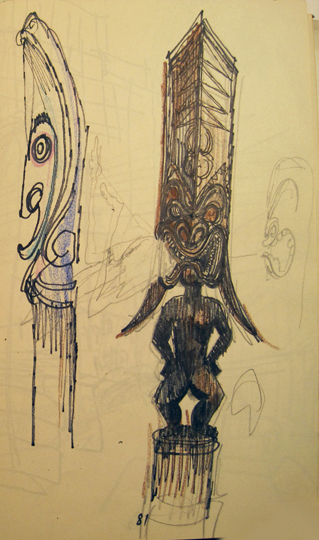
This devilish totem inspired the gag in the next image 
Again, these two remain, I believe, unpublished.

 After Oahu Searle's next assignment was to report from the Catskills which I'll get to in the next post . . .

(Thanks to Mark Stanleigh for the Holiday mag contributions, Chris Beetles Gallery for the letter transcription and Ronald for letting me photograph his sketchbooks.)